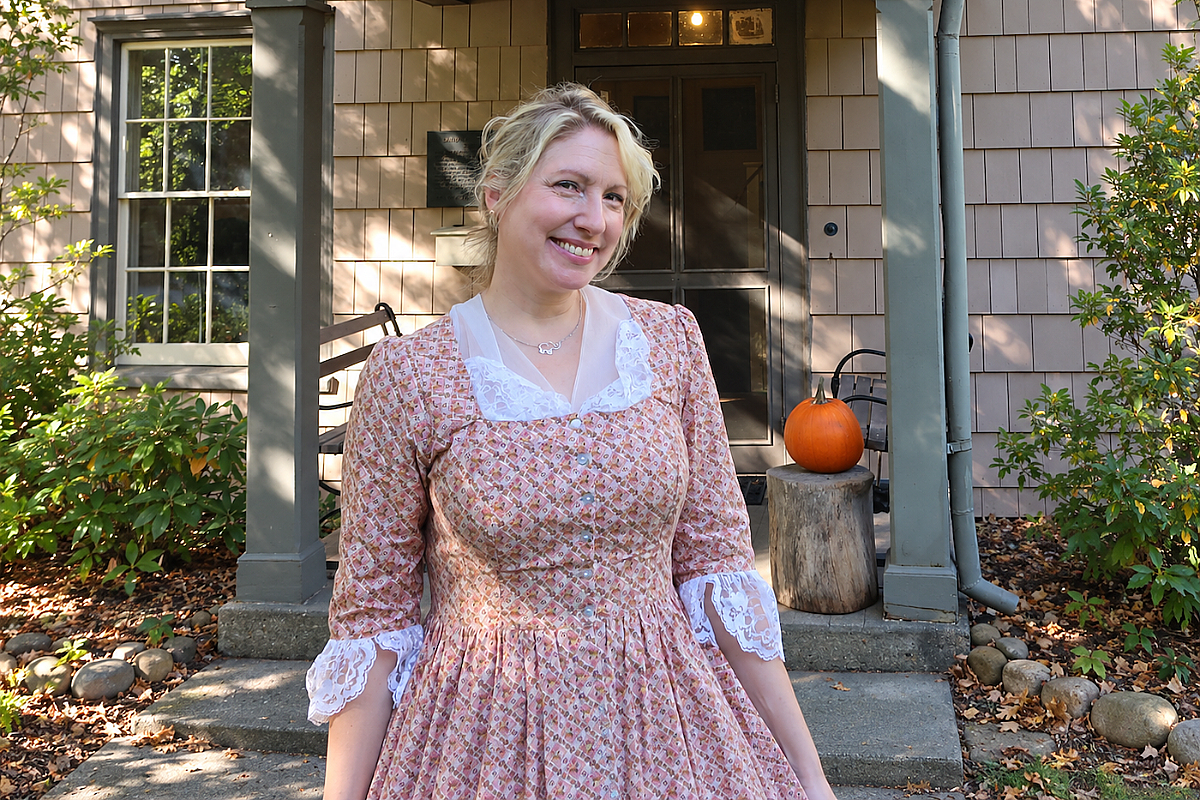
Mention Flushing, NY, and most people think baseball, tennis, or the city’s renowned Asian cuisine. Emily Vieyra-Haley ’22 sees it differently. As a costumed docent at the Bowne House, she spends her days interpreting more than three centuries of American history — one visitor at a time.
Vieyra-Haley traces her interest in the past to childhood, when “Little House on the Prairie” first sparked her curiosity about early American life. She began volunteering at Old Bethpage Village in 2017 while completing a history major at SUNY Binghamton, and took part in community archaeology digs starting in 2015 — partly, she says, to honor her mother’s own background in archaeology.
It was Empire State University’s heritage preservation certificate program that led her to Bowne House, where she went on to earn a master’s degree and now also works as an adjunct faculty member handling prior learning credit.
A House With a History
Built in 1661 by English settler John Bowne, the house became historically significant the following year, when Bowne was arrested for hosting Quaker meetings in defiance of Governor Peter Stuyvesant, who had restricted worship to the Dutch Reformed Church. Bowne appealed to the Dutch West India Company, citing the town charter’s own protections for “liberty of conscience,” won his case, and returned home to continue hosting Quaker gatherings for 40 more years.
Vieyra-Haley is quick to highlight his wife Hannah’s own role in that story. Hannah, she says, “persevered and went on to have eight children with him” while becoming a Quaker minister in her own right.
Recent research suggests the family’s commitment to pacifism may have forced them to quarter Hessian soldiers against their will during the Revolutionary War, facing persecution from both sides of the conflict.
The Bowne House is also Queens’ only site on the National Park Service’s Underground Railroad Network to Freedom — documentation shows people hid on the property and in family-owned cellars before being transported, via Whitestone, to Connecticut.
The house survives as a museum today thanks in large part to sisters Anna and Bertha Parsons, ninth-generation descendants who converted it in the 1940s, using contemporary publicity tactics that included a radio broadcast by Mayor Fiorello LaGuardia.
History You Can Touch
As the site’s sole costumed docent, Vieyra-Haley owns six mostly Victorian-era dresses, sourced from dressmakers in Michigan and Oklahoma, with accessories found on Etsy. She wears them not for spectacle, but to make history “accessible, attainable, and relatable” for the visitors who walk through the door.